
Reliability of a Smartphone App to Objectively Monitor Performance Outcomes in Degenerative Cervical Myelopathy: Observational Study
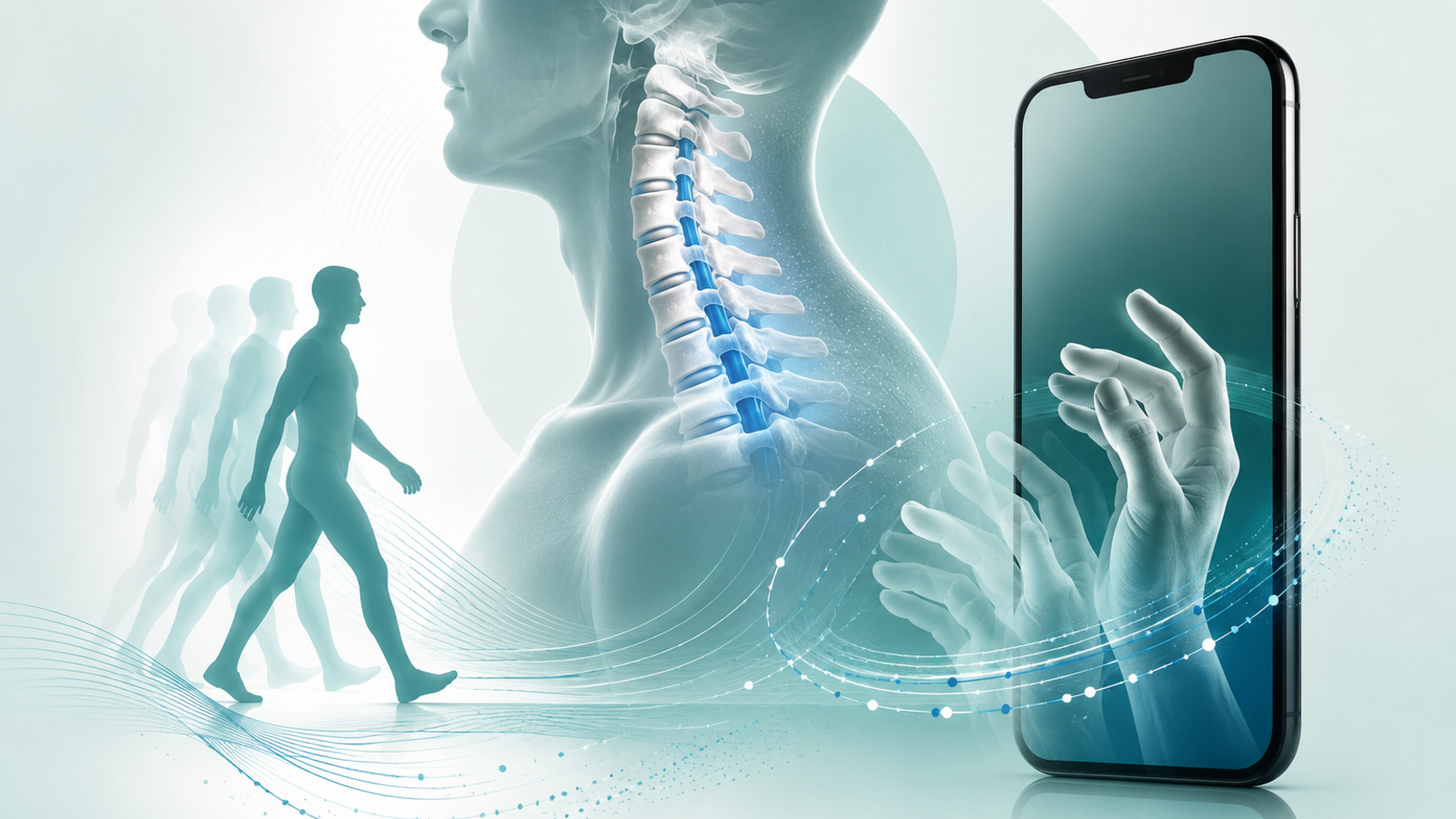
Published research co-authored by Mr Gordan Grahovac
This observational study evaluated whether a smartphone app could reliably measure performance outcomes in people with degenerative cervical myelopathy. It matters because remote or objective monitoring tools may support follow-up and research, but they need validation before wider use.
Research snapshot
Article title: Reliability of a Smartphone App to Objectively Monitor Performance Outcomes in Degenerative Cervical Myelopathy: Observational Study
Authors: A Yanez Touzet, T Houhou, Z Rahic, A Kolias, S Yordanov, D B Anderson, I Laufer, M Li, Gordan Grahovac, M R N Kotter, B M Davies, MoveMed Ltd
Publication type: Journal article
Publication date: 24 May 2024
Publication details: JMIR Formative Research. 2024;8:e56889.
PMID: 38787602
PMCID: PMC11161705
DOI: 10.2196/56889
Study type: Observational study
Mr Grahovac’s involvement: Listed author on the publication
Original publication: View the original publication on PubMed
What this paper looked at
This paper looked at performance monitoring in degenerative cervical myelopathy using a smartphone app. The goal was to assess reliability of objective app-based measures in a condition that can affect walking, hand function and daily activity.
Key points from the publication
The indexed records confirm the study as an observational JMIR Formative Research article with PubMed and PubMed Central records. Detailed numerical reliability results should be checked in the full text before being used in copy.
Clinical relevance
The study is clinically relevant because validated digital tools may help track function, support follow-up and improve research measures in degenerative cervical myelopathy.
What this means in context
A smartphone app is not a substitute for clinical examination, imaging or specialist review. Digital monitoring may add useful information when interpreted alongside symptoms, neurological findings and the wider clinical picture.
View published abstract
The following abstract is reproduced from the original publication and is provided for reference. It may include technical terminology intended for clinical or academic audiences.
Background: Developing new clinical measures for degenerative cervical myelopathy (DCM) is an AO Spine RECODE-DCM Research, an international and multi-stakeholder partnership, priority. Difficulties in detecting DCM and its changes cause diagnostic and treatment delays in clinical settings and heightened costs in clinical trials due to elevated recruitment targets. Digital outcome measures can tackle these challenges due to their ability to measure disease remotely, repeatedly, and more economically.
Objective: The aim of this study is to assess the reliability of the MoveMed battery of performance outcome measures.
Methods: A prospective observational study in decentralized secondary care was performed in England, United Kingdom. The primary outcome was to determine the test-retest reliability of the MoveMed performance outcomes using the intraclass correlation (ICC) of agreement . The secondary outcome was to determine the measurement error of the MoveMed performance outcomes using both the SE of the mean (SEM) of agreement and the smallest detectable change (SDC) of agreement . Criteria from the Consensus-Based Standards for the Selection of Health Measurement Instruments (COSMIN) manual were used to determine adequate reliability (ie, ICC of agreement ≥0.7) and risk of bias. Disease stability was controlled using 2 minimum clinically important difference (MCID) thresholds obtained from the literature on the patient-derived modified Japanese Orthopaedic Association (p-mJOA) score, namely, MCID ≤1 point and MCID ≤2 points.
Results: In total, 7 adults aged 59.5 (SD 12.4) years who live with DCM and possess an approved smartphone participated in the study. All tests demonstrated moderate to excellent test-retest coefficients and low measurement errors. In the MCID ≤1 group, ICC of agreement values were 0.84-0.94 in the fast tap test, 0.89-0.95 in the hold test, 0.95 in the typing test, and 0.98 in the stand and walk test. SEM of agreement values were ±1 tap, ±1%-3% stability score points, ±0.06 keys per second, and ±10 steps per minute, respectively. SDC of agreement values were ±3 taps, ±4%-7% stability score points, ±0.2 keys per second, and ±27 steps per minute, respectively. In the MCID ≤2 group, ICC of agreement values were 0.61-0.91, 0.75-0.77, 0.98, and 0.62, respectively; SEM of agreement values were ±1 tap, ±2%-4% stability score points, ±0.06 keys per second, and ±10 steps per minute, respectively; and SDC of agreement values were ±3-7 taps, ±7%-10% stability score points, ±0.2 keys per second, and ±27 steps per minute, respectively. Furthermore, the fast tap, hold, and typing tests obtained sufficient ratings (ICC of agreement ≥0.7) in both MCID ≤1 and MCID ≤2 groups. No risk of bias factors from the COSMIN Risk of Bias checklist were recorded.
Conclusions: The criteria from COSMIN provide "very good" quality evidence of the reliability of the MoveMed tests in an adult population living with DCM.
Keywords: mobile phone; neurology; patient outcome assessment; psychometrics; reproducibility of results; smartphone; spinal cord compression.
View the original publication on PubMed
About Mr Gordan Grahovac
Mr Gordan Grahovac is a Consultant Neurosurgeon and Complex Spinal Surgeon with expertise in managing complex spinal and neurosurgical conditions.
His work includes the assessment and treatment of patients with degenerative spinal conditions, spinal cord compression, spinal tumours, complex spinal pathology and conditions requiring specialist neurosurgical input.
His approach focuses on careful diagnosis, appropriate treatment planning and helping patients understand their options clearly.
Important note
This page is for educational purposes only and should not be taken as individual medical advice.
If you or someone you know has symptoms such as worsening headache, confusion, drowsiness, weakness, changes in speech, seizures, balance problems or symptoms following a head injury, seek urgent medical advice.
